A competition at the intersection of information theory and machine learning,
held in conjunction with the IEEE International Symposium on Information Theory,
with final presentations & prize ceremony at IEEE ISIT 2026 in Guangzhou, China.
Online · May 24 – June 24, 2026 · Finals · July 2, 2026 · Guangzhou
"Men do not mirror themselves in running water, but in still water."
The Student and Outreach Committee of the IEEE Information Theory Society is delighted to
announce the 4th edition of the Data-to-Information (D2I) competition, jointly organized with
the IEEE Information Theory Society Guangzhou Chapter, held in conjunction
with the IEEE International Symposium on Information Theory in Guangzhou.
In this edition, we explore the theme of reflection. Following Zhuangzi's advice,
we ask whether modern wireless systems might benefit from making the channel sufficiently
calm before attempting transmission. This competition sits at the intersection of information
theory and machine learning, challenging participants to extract as much mutual
information as possible from a realistic Reflective Intelligent Surface (RIS) dataset
and to design robust algorithms that work in practice.
What is a Reflective Intelligent Surface?
A RIS is a synthetically produced meta-surface that can programmatically manipulate
the phase of a radio wave reflected from it. Traditional wireless channels treat the
environment as a fixed and uncontrolled medium; RISs transform this paradigm by embedding
hundreds of programmable reflecting elements into the environment itself. By configuring these
elements, the transmitter can steer energy toward the receiver and counteract fading.
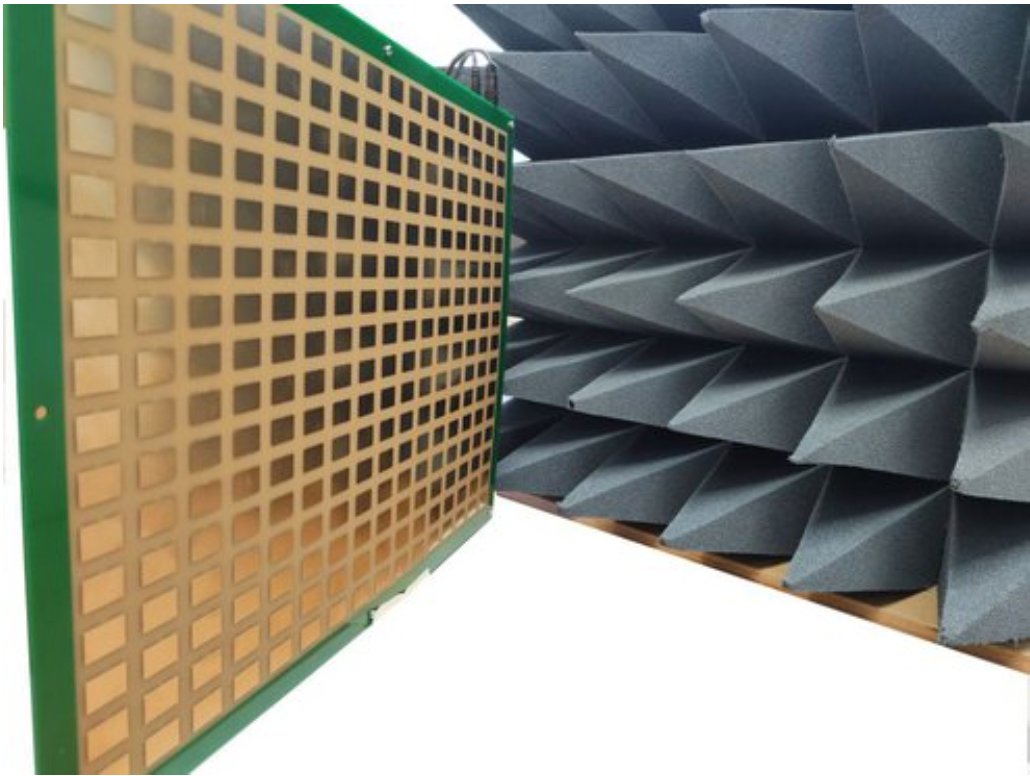
A 16 × 16 RIS prototype (256 programmable elements) positioned in front of an
anechoic chamber — the measurement setup used to acquire the BRISC dataset.
When the transmitter and receiver are synchronized, the received signal carries rich
channel state information (CSI) that encodes both the direct path and the
reflected contributions. Understanding and exploiting this high-dimensional CSI —
a 256-element binary configuration space in our dataset — is the core challenge of the
competition.
Who this is for: researchers and practitioners working in information
theory, machine learning, signal processing, and wireless networking. Students and
early-career researchers are especially encouraged to join. No prior RIS
experience required — strong baselines and a starter notebook are provided.
Competition Tasks
Four challenges, one dataset
The competition consists of one warm-up plus three scored tasks of increasing
difficulty. While each task builds partially on the previous ones, participants
are free to tackle any task independently. Final rankings are based on cumulative
performance across all tasks.
A detailed specification document — with evaluation scripts, point weightings, and
submission procedures — will be released on the Kaggle page at the start of the
competition.
Task 0 · Warm-Up
00
Channel Exploration
Learn a mapping between channel realizations: given CSI under one configuration, predict
CSI under a related one — a different RIS phase setting, frequency shift, antenna
subset, or spatial displacement. This task grounds participants in the structure of the
dataset and the relationships between channel observations.
Metric: Frobenius norm vs. ground truth
Task 1 · Main
01
Mutual Information Estimation
Given a set of RIS configurations and their CSI, estimate the mutual information
between transmitted and received signals under Gaussian signaling of fixed power. The
core challenge is designing estimators that generalize across different
transmitter positions and RIS states. Reference MI values are computed via high-fidelity
Monte-Carlo simulation and well-established neural MI estimators.
Score: ½ · RMSE + ½ · (1 − Spearman ρ)
Task 2 · Main
02
Phase & Beamforming Optimization
For each test transmitter position, output a binary phase-shift vector for the 256 RIS
elements and a transmit beamforming vector satisfying a power constraint — jointly
optimized to maximize the achievable rate. Solutions can combine differentiable neural
MI objectives with analytical baselines (MRT, coordinate-wise alignment, dominant
eigenvectors).
Metric: Average MI across positions · higher is better
Task 3 · Main
03
Physical-Layer Secret Key Generation
Alice and Bob exchange pilot signals to estimate a reciprocal wireless channel assisted
by a RIS. Channel estimates are quantized, decoded via LDPC, and hashed into a shared
secret key. An eavesdropper, Eve, observes her own channel to Bob and attempts to infer
the key. Given Eve's observations and a training set of Alice–Bob bit sequences,
participants must predict Alice's bits for unseen RIS configurations — quantifying
the secret-key capacity CSK = I(X;Y) − I(X;Z)
in practice.
Metric: Hamming distance between true and guessed key
★ Special Award
The Zhuangzi Prize — for the most promising newcomers with best presentation
In addition to the main prizes, a dedicated award goes to the team with the least
prior experience that achieves the strongest performance and impress the committee with their presentation. This is intended to encourage
participation from newcomers and to recognize outstanding results achieved through sheer
determination, a non-trivial amount of caffeine, and — inevitably — a
certain degree of vibe coding.
Dataset
BRISC — real-world RIS measurements
Participants work with the Broadband RIS Channel (BRISC) dataset, a
publicly available collection of CSI measurements recorded in a controlled indoor
environment. A 16 × 16 RIS prototype (256 elements) mounted on an acrylic support is driven
by CMOS-based switches that toggle each element between two reflection states —
providing binary phase-amplitude control.
256RIS elements
9TX positions
~10kconfigs / position
5 GHzcarrier band
Transmitter and receiver are software-defined radios synchronized via an OctoClock. The
direct line-of-sight path between them is blocked by absorbers, so the received signal is
dominated by reflected contributions through the RIS. For each configuration, complex CSI is
recorded across multiple subcarriers and receiver antennas.
The dataset includes the known RIS phase configuration, the transmitter position (one of nine),
and the recorded CSI — but not explicit rate or mutual-information labels.
Participants must estimate these quantities from the CSI itself. The dataset and a starter
code package — including utilities for loading CSI, computing basic channel metrics, and
converting RIS configurations to phase values — will be released at the start of the
competition.
Reference: BRISC: A Dataset of Channel Measurements
at 5 GHz With a Reflective Intelligent Surface —
arXiv:2602.21102
Schedule
Timeline & milestones
The competition runs fully online from registration through final submission.
Top teams will then present their approaches during a hybrid final session held as
part of IEEE ISIT 2026 — presenters can join either in person in Guangzhou or
remotely.
April 24, 2026
Registration Opens
Individual and team registration opens through the competition website. Indicate whether you plan to attend IEEE ISIT 2026 in person or participate fully remotely.
May 24, 2026
Competition Starts · Teams Announced
Registration closes. Individuals are matched into teams and pairings are announced. Dataset and starter code go live on Kaggle. Remote working phase begins.
May 24 – June 24
Remote Working Phase
Teams develop their algorithms. Up to 5 submissions per day per team. Public leaderboard provides live feedback throughout.
June 24, 2026
Final Submission Deadline
The last submission of each team is considered for the private leaderboard. Teams also submit code and trained models for reproducibility.
July 2, 2026
Hybrid Finals & Prize Ceremony · IEEE ISIT 2026
Selected teams present their approaches at IEEE ISIT 2026 in Guangzhou — in person or remotely. Winners announced and prizes awarded.
Participation
Who can take part?
The competition is open to teams from academia, industry, and government labs worldwide.
Students and early-career researchers are especially encouraged to join. The only
formal requirement is that at least one team member be an IEEE Information Theory Society
member — everything else is flexible, and we will make every effort to facilitate
participation and team formation.
ⓘ
Required
IEEE IT Society Membership
At least one team member must be a registered member of the IEEE Information Theory
Society. Membership will be verified during registration.
5
Team Size
Teams of up to five people. Solo registrants are welcome — organizers will match
individuals into teams during the registration window.
⟲
Fully Remote-Friendly
No in-person attendance required at any stage. The working phase is entirely online, and
selected finalists may present at IEEE ISIT 2026 either in person in Guangzhou or
remotely — whichever works for you.
∅
Open Backgrounds
Information theory, machine learning, signal processing, networking — all welcome.
No prior RIS experience is assumed; starter code and strong baselines are provided.
Registration
How to join
Registration is now open. During registration, you will indicate
whether you plan to attend IEEE ISIT 2026 in person or participate remotely, and whether
you are registering as an individual or as part of a team. Detailed instructions for dataset
download, baseline code, and submission will be published on the Kaggle page shortly before
the competition launch on May 24. Our community Slack workspace is also live — a space for questions, announcements,
and, for those looking for teammates, a dedicated #team-formation channel once you’ve joined.
The competition specification, baseline code, the Kaggle hub, and the live
team roster — all the materials you’ll need to take part, gathered
in one place.
Scored entries are made on Kaggle throughout the working phase, with the public
leaderboard giving live feedback. Separately, by the final deadline on
June 24, 2026, each team submits its code and trained
models for reproducibility through the submission portal below.
Package your code as a single archive. For large model checkpoints, please include a
shared link — Google Drive, Hugging Face, or a GitHub release — rather than
uploading the files directly, so submissions stay light and easy to retrieve.
Submission package
</>
Required
Code
Source code ready to run on Ubuntu 22.04 with CUDA 12, packaged as a single archive.
≣
Required
Environment Spec
A requirements.txt or environment.yml capturing every dependency needed to reproduce your results.
Optional
Video & Slides
A walkthrough of up to 5 minutes plus slides — overview, method, and results.
Optional
Poster / Diagram
A single-page poster or diagram summarizing your approach at a glance.
Sharing of video materials. Submitted videos may be shared on
IEEE ITSoc channels to showcase participants' work. If you prefer
your video not to be shared, you can opt out at submission —
the form includes a checkbox for this.
Opens the submission form in a new tab. Final deadline: June 24, 2026.
Awards
Prizes & recognition
The competition is sponsored by the IEEE Information Theory Society —
through its Student and Outreach Committee — and by Techphant Consulting
Group. Prizes are awarded for overall performance across all tasks, plus the
dedicated Zhuangzi Prize for the most promising newcomers.
Confirmed Prize Pool
USD$5,000
— contributed by the IEEE IT Society and Techphant Consulting Group —
$3,000IEEE IT Society
$2,000Techphant Consulting
The final allocation — including the split between top performers and the
Zhuangzi Prize — will be announced at the start of the competition on May 24,
alongside the Kaggle launch.
Final Breakdown Announced at Launch
Organizing Committee
The team behind The Still Mirror
The competition is organized by the IEEE Information Theory Society Student and
Outreach Committee, with dedicated student technical leads and local support at
IEEE ISIT 2026.
Student & Outreach Committee
AL
Alejandro Lancho
Universidad Carlos III de Madrid
HN
Khac-Hoang Ngo
Linköping University
SR
Stefano Rini
National Yang Ming Chiao Tung University
Student Technical Leads
MP
Mattia Piana
University of Padova
FM
Farhad Mirkarimi
McGill University
MH
Markus Heinrichs
University of Cologne
NN
Nam Nguyen
Oregon State University
Lineage
Previous D2I editions
The Data-to-Information competition series has run annually alongside the IEEE International
Symposium on Information Theory since 2023, bringing together students and researchers
around open, reproducible challenges at the intersection of information theory and machine
learning.
Register in April, work remotely through June, and — if selected — present your
approach at IEEE ISIT 2026 in Guangzhou, in person or from wherever you are. Whether you come
from information theory, machine learning, or somewhere else entirely, we'd love to have you.